


 Cart
Cart
 sales@molnova.com


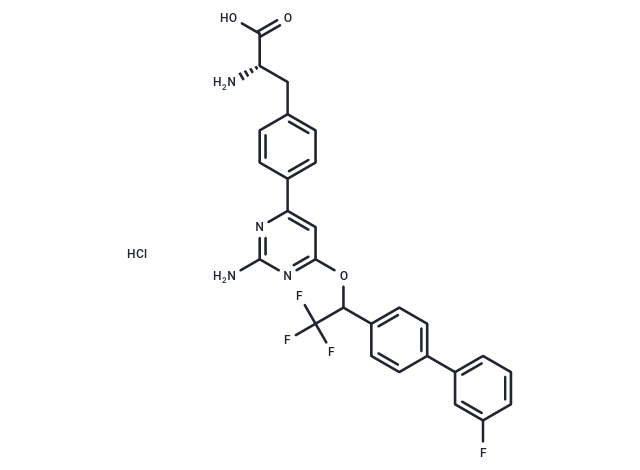
LP-533401 hydrochloride
CAS No. 1040526-12-2
LP-533401 hydrochloride( —— )
Catalog No. M33410 CAS No. 1040526-12-2
LP-533401 hydrochloride is a peripheral Tph inhibitor that cannot cross the blood-brain barrier that inhibits 5-hydroxytryptamine synthesis and can be used to study periodontal disease and hepatic steatosis.
Purity : >98% (HPLC)
 COA
Datasheet
HNMR
HPLC
MSDS
Handing Instructions
COA
Datasheet
HNMR
HPLC
MSDS
Handing Instructions
| Size | Price / USD | Stock | Quantity |
| 2MG | 52 | Get Quote |


|
| 5MG | 77 | Get Quote |
|
| 10MG | 117 | Get Quote |
|
| 500MG | Get Quote | Get Quote |
|
| 1G | Get Quote | Get Quote |
|
Biological Information
-
Product NameLP-533401 hydrochloride
-
NoteResearch use only, not for human use.
-
Brief DescriptionLP-533401 hydrochloride is a peripheral Tph inhibitor that cannot cross the blood-brain barrier that inhibits 5-hydroxytryptamine synthesis and can be used to study periodontal disease and hepatic steatosis.
-
DescriptionLP-533401 hydrochloride is a tryptophan hydroxylase 1 inhibitor that regulates serotonin production in the gut.
-
In Vitro——
-
In Vivo——
-
Synonyms——
-
PathwayGPCR/G Protein
-
Target5-HT Receptor
-
Recptor5-HT Receptor
-
Research Area——
-
Indication——
Chemical Information
-
CAS Number1040526-12-2
-
Formula Weight562.94
-
Molecular FormulaC27H23ClF4N4O3
-
Purity>98% (HPLC)
-
SolubilityIn Vitro:?DMSO : 25 mg/mL (44.41 mM; Ultrasonic )
-
SMILESCl.N[C@@H](Cc1ccc(cc1)-c1cc(OC(c2ccc(cc2)-c2cccc(F)c2)C(F)(F)F)nc(N)n1)C(O)=O
-
Chemical Name——
Shipping & Storage Information
-
Storage(-20℃)
-
ShippingWith Ice Pack
-
Stability≥ 2 years
Reference
1. Yadav, V.K., et al. Inhibition of gut-derived serotonin synthesis: A potential bone anabolic treatment. Nat. Med. 16(3), 308-312 (2010).
molnova catalog



related products
-
Lintopride HCl
Lintopride HCl is a 5HT-4 antagonist.
-
p-MPPF dihydrochlori...
p-MPPF dihydrochloride is a selective 5-HT antagonist that dose-dependently antagonizes hypothermia induced by 8-hydroxy-2-(di-n-propylamino)tetralin (8-OH-DPAT) and can be used to study neurological diseases.
-
Quipazine dimaleate
Quipazine dimaleate is a selective 5-HT3 agonist.
